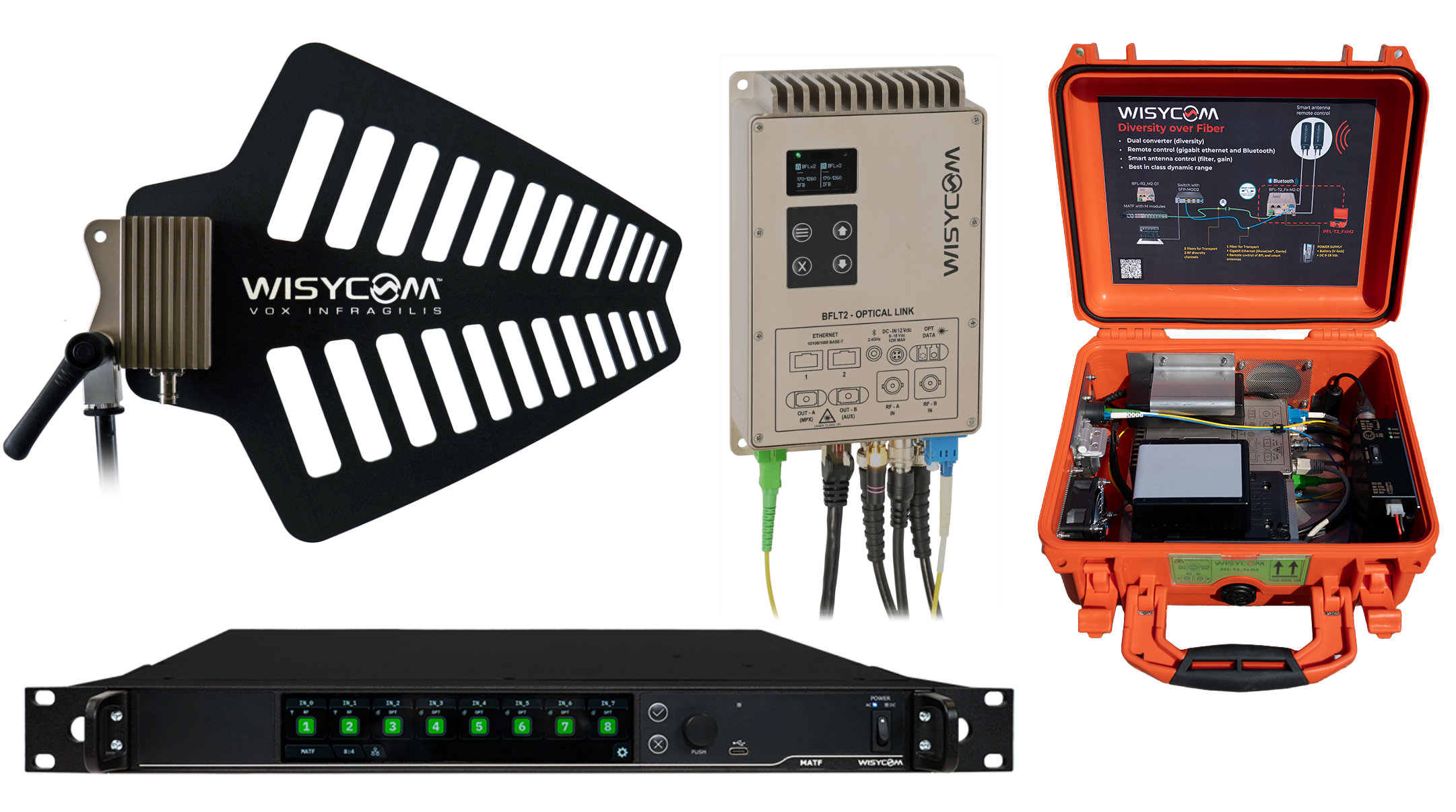
RFoF technology operates by converting electrical RF signals into optical signals typically at the antenna pick up point. These optical signals are transmitted through fiber cables—sometimes over tens of kilometers—before being converted back to electrical RF signals to feed the receivers. This technology can also be used for IEM/IFB, transmitting signals via fiber to a remote location. This approach enables long-distance, high-quality transmission that is highly resistant to interference and signal degradation. Unlike traditional RF antenna coaxial cables, RFoF systems provide a significantly low loss (0.4 dB/km instead of 200 dB/km via a typical RF cable) and maintain signal integrity over much greater distances, even in challenging environments.
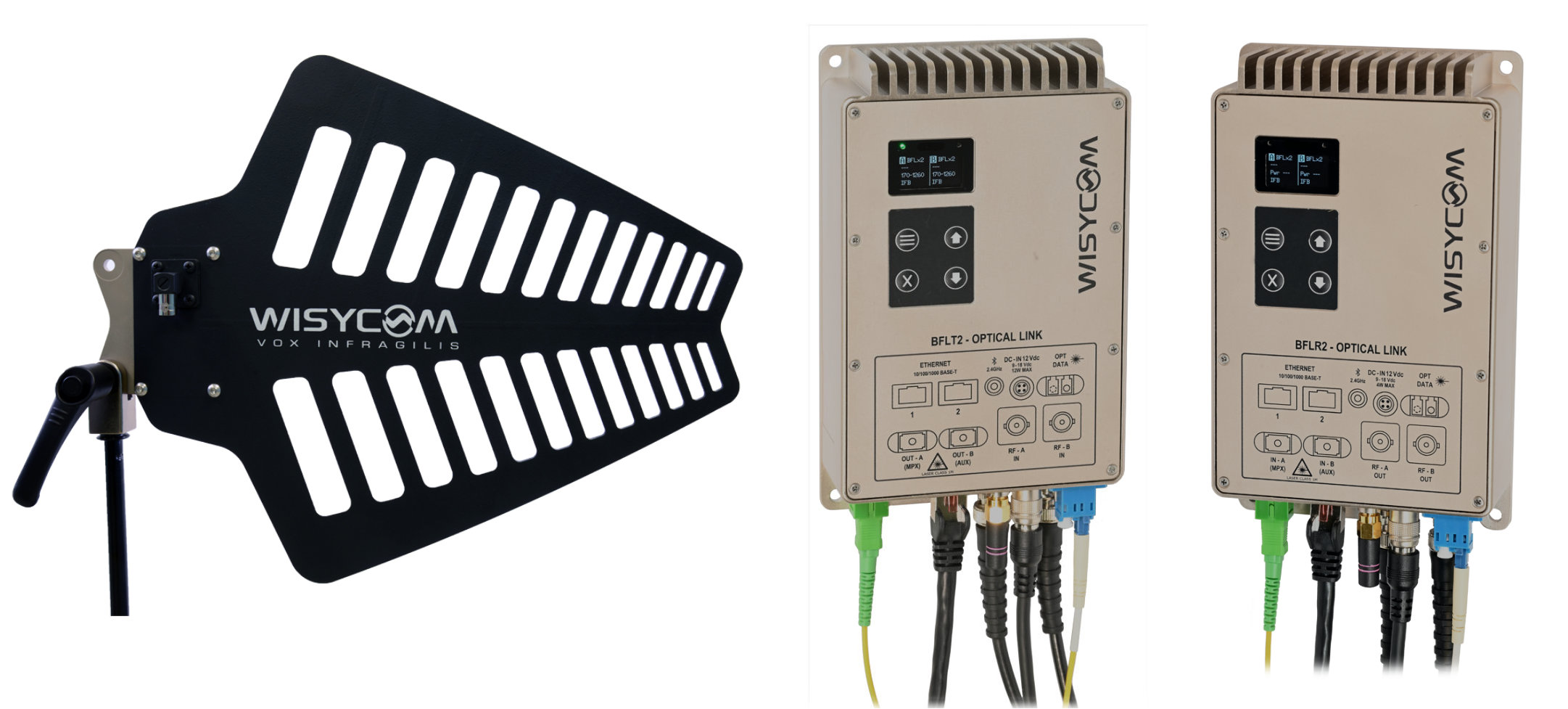
RF signals are converted to optical signals at the antenna position, transported over fiber, and converted back to RF at the receiver.
Centralization in a technical room using fiber connections allows for easy deployment of your wireless infrastructure.
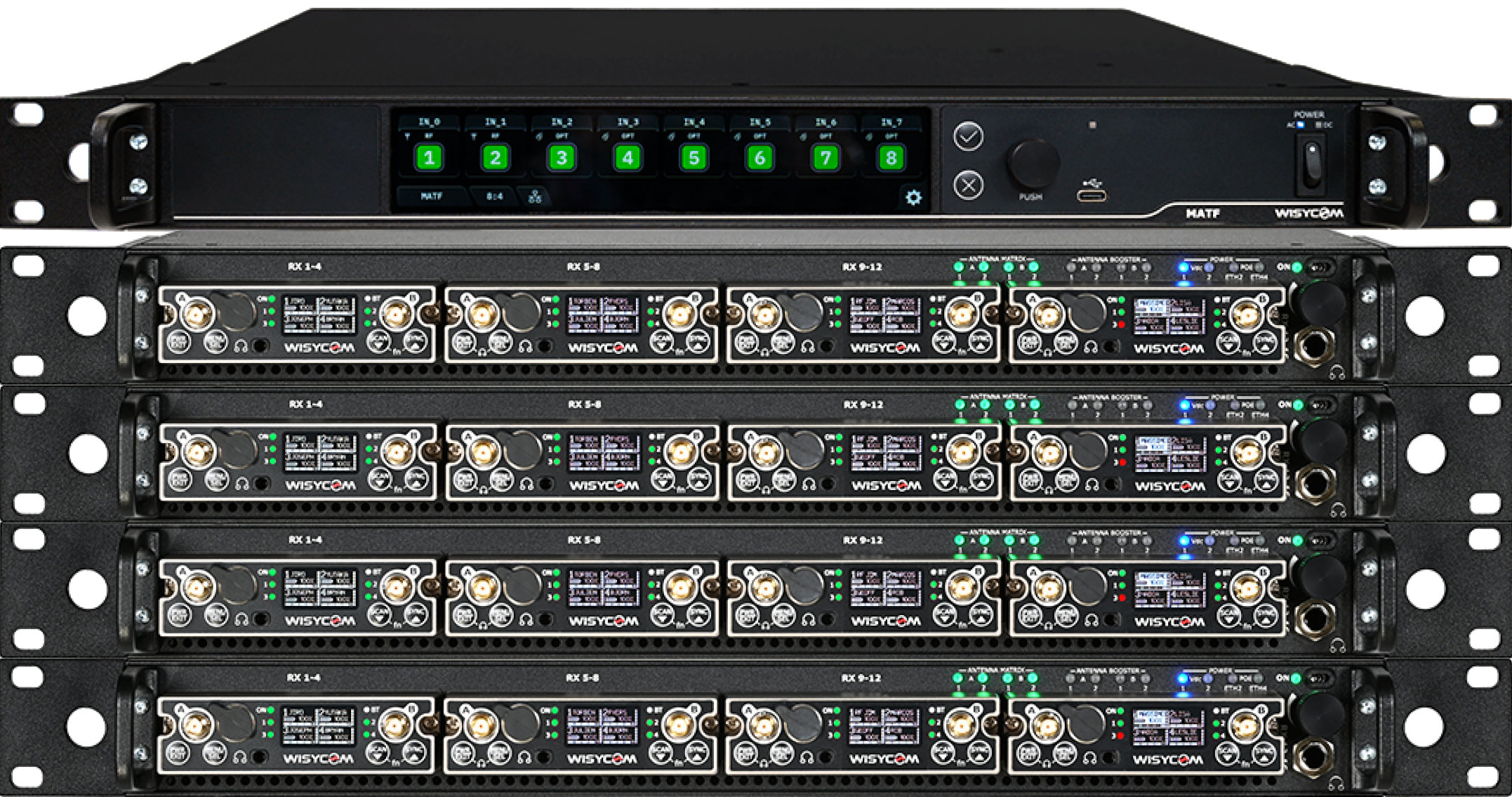
Centralized RF infrastructure, based on Wisycom MATF and RF-over-Fiber endpoints, enables receivers to be shared across multiple spaces—illustrated here with four MRK16 Ultra-Wideband systems, delivering a total of 64 channels.
Why is RFoF revolutionary?
Traditional coaxial cables are heavy, expensive, and already at short distances you will experience signal loss. Cables longer than 100 meters quickly become unpractical due to the high RF attenuation.
Fiber cables, by contrast, can span 10 kilometers or more without significant loss and are lighter, easier to install, and more flexible. This makes RFoF ideal for modern broadcast, live events, and corporate installations where reliability and scalability are essential.
Furthermore, RFoF optimizes overall capital expenditure (CAPEX) through shared resources.
Key Advantages of RFoF
- Long-distance transmission: Fiber cables can carry RF signals over great distances—10 km or more—without the need for amplifiers or repeaters.
- Immunity to noise: Fiber is unaffected by electromagnetic interference, ensuring clean and stable signal transmission even in environments with significant electrical noise.
- High bandwidth: RFoF supports a wide frequency range and multiple signals simultaneously, making it suitable for complex, multi-channel setups.
- Flexible installation: Fiber cables are lightweight, thin, and easy to route through buildings or across large venues.
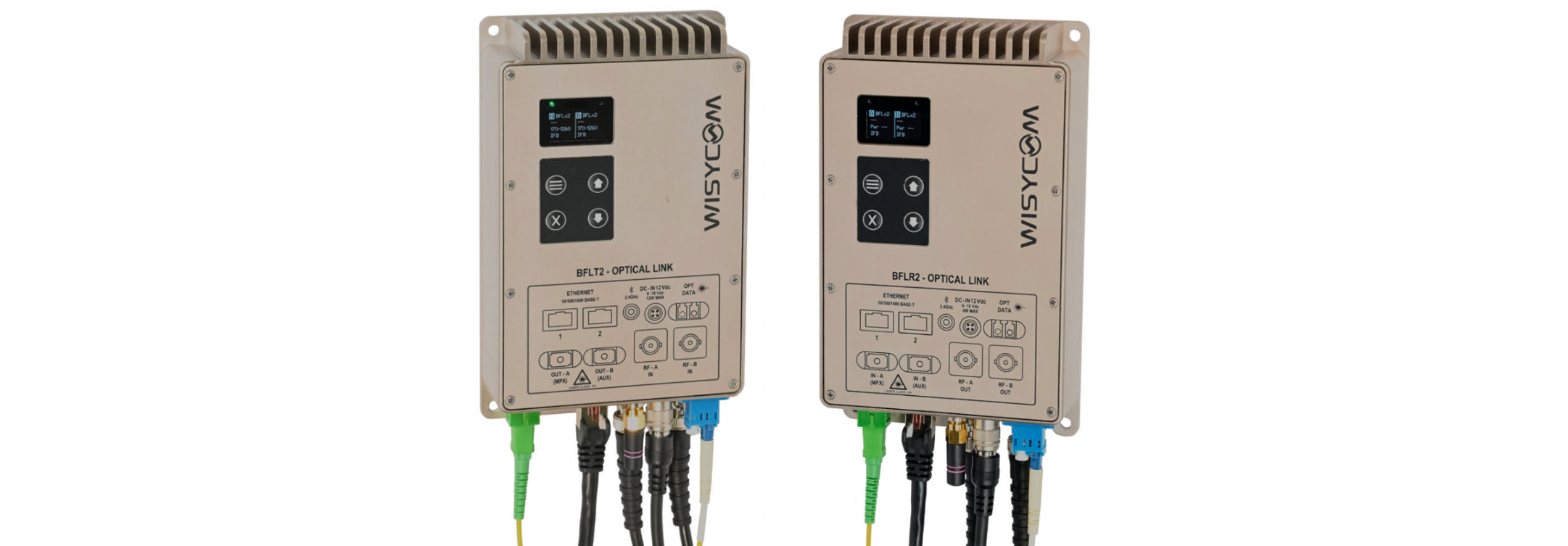
- Multi-signal transmission: Some modern RFoF systems can simultaneously transmit RF, Ethernet and trunk, for example Audio over IP (such as Dante), over a single fiber. This integration enables transport of data, intercom, and live video, reducing infrastructure complexity.
- Remote control: Some systems allow remote management of antennas and filters via software, which optimize performance and minimize interference at remote locations.
Use cases: RFoF in action
Outside Broadcast:
RFoF enables audio signals from wireless microphones and even IFB signals to travel from/to antennas placed throughout a stadium, directly to/from a technical room—sometimes hundreds of meters away. This ensures reliable RF coverage regardless of the distance.
RFoF enables antenna placement close to performers while receivers remain hundreds of meters away in OB trucks or control rooms.
TV Production and Theatres:
In broadcast facilities and theatres with multiple studios, stages or performance areas, RFoF allows receivers to be centralized in a technical room while transmitters can be freely moved between studios, stages, or sets as needed.
This centralized approach maximizes equipment utilization, reduces setup time, and simplifies coordination across productions. In fast-paced environments—such as reality TV formats or theatrical productions with changing scenes, mobile performers, or simultaneous rehearsals—antennas can be strategically placed to provide consistent, seamless RF coverage.
The result is reliable, uninterrupted audio performance, allowing talent to move freely between zones, stages, or backstage areas without dropouts or reconfiguration. The flexibility of fiber connections enables easy deployment of wireless infrastructure and optimizes CAPEX through shared resources. All operations can be managed remotely via Ethernet.
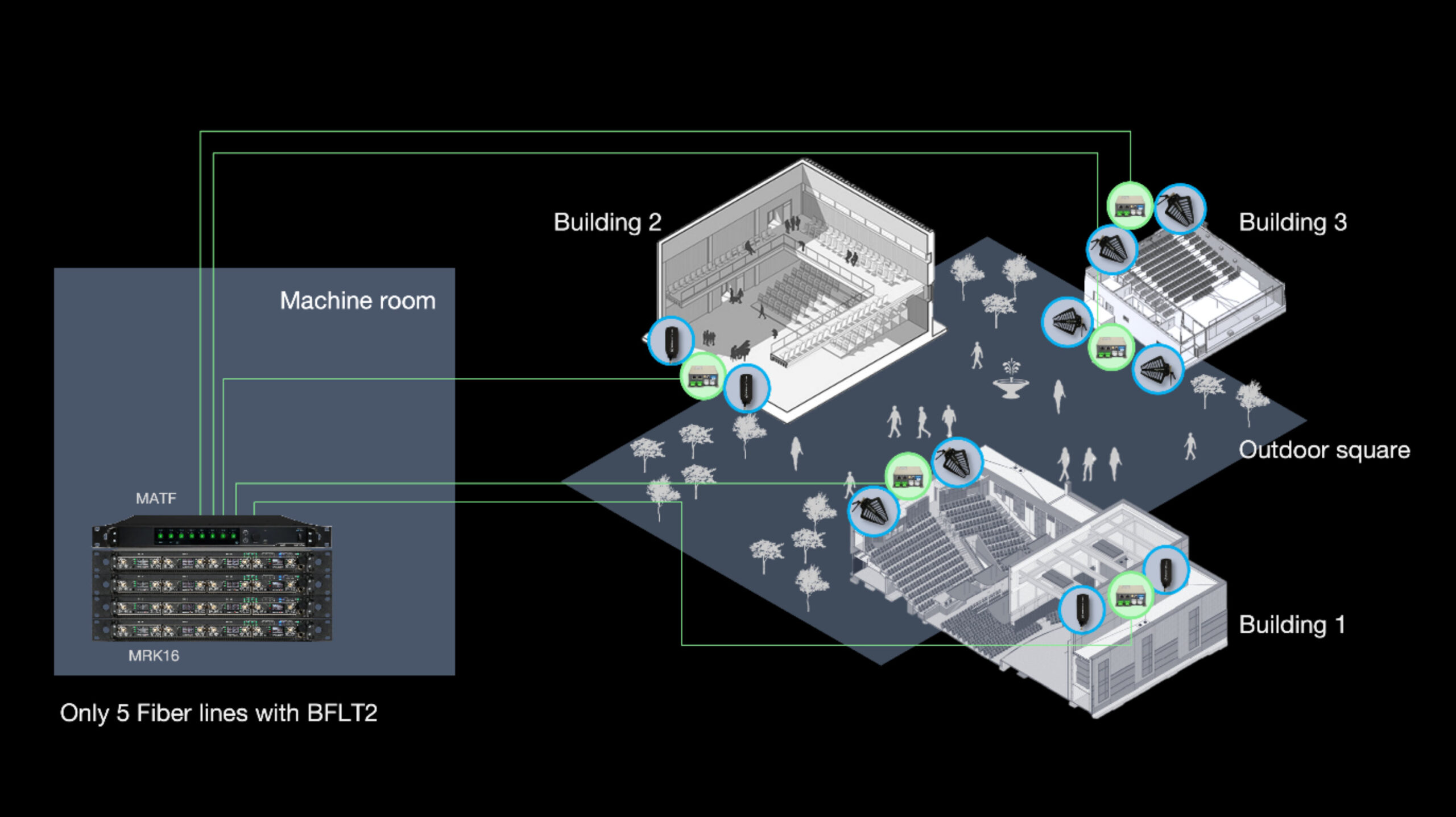
Distributed antenna zones are connected via fiber to a centralized technical room, allowing shared receivers and seamless RF coverage across multiple spaces.
Live Events:
Concerts and festivals often span large outdoor areas with big stages, catwalks, or even multiple stages. RFoF makes it possible to place antennas close to performers, reducing the risk of signal dropouts and interference from LED walls and other sources.
Talents can move freely across the venue, while engineers monitor and control the system remotely, ensuring every note and word reaches the audience without interruption.
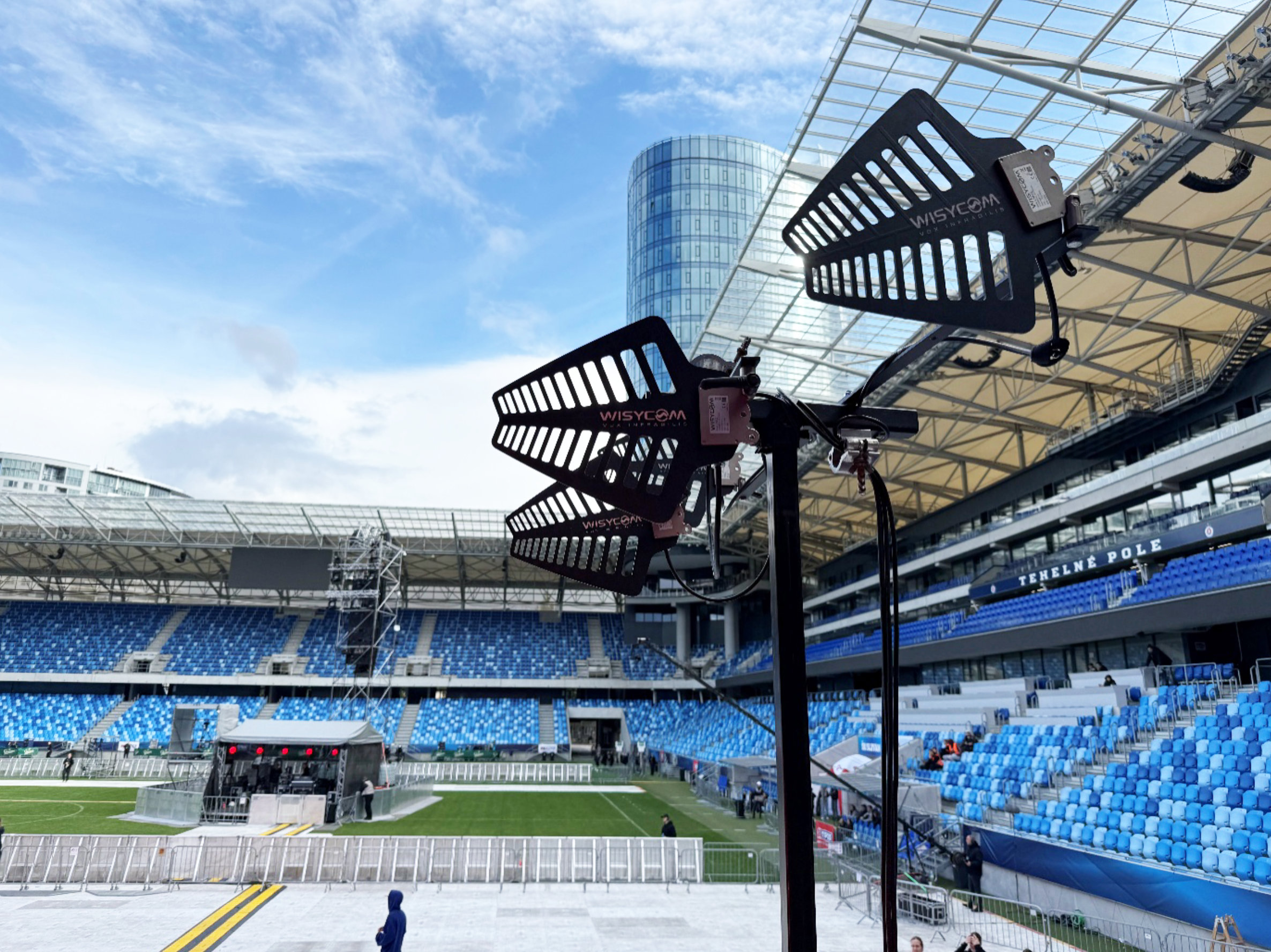
In large live productions, RFoF allows antennas to be placed close to performers—even across multiple stages—while engineers monitor everything centrally.
Conferences and Corporate Installations:
Modern conference centers and meeting rooms benefit from RFoF’s invisible infrastructure. Fiber cables can be routed discreetly through walls and ceilings, allowing centralized control and easy expansion. Presenters and attendees enjoy reliable wireless audio, while technical staff manage the system remotely.
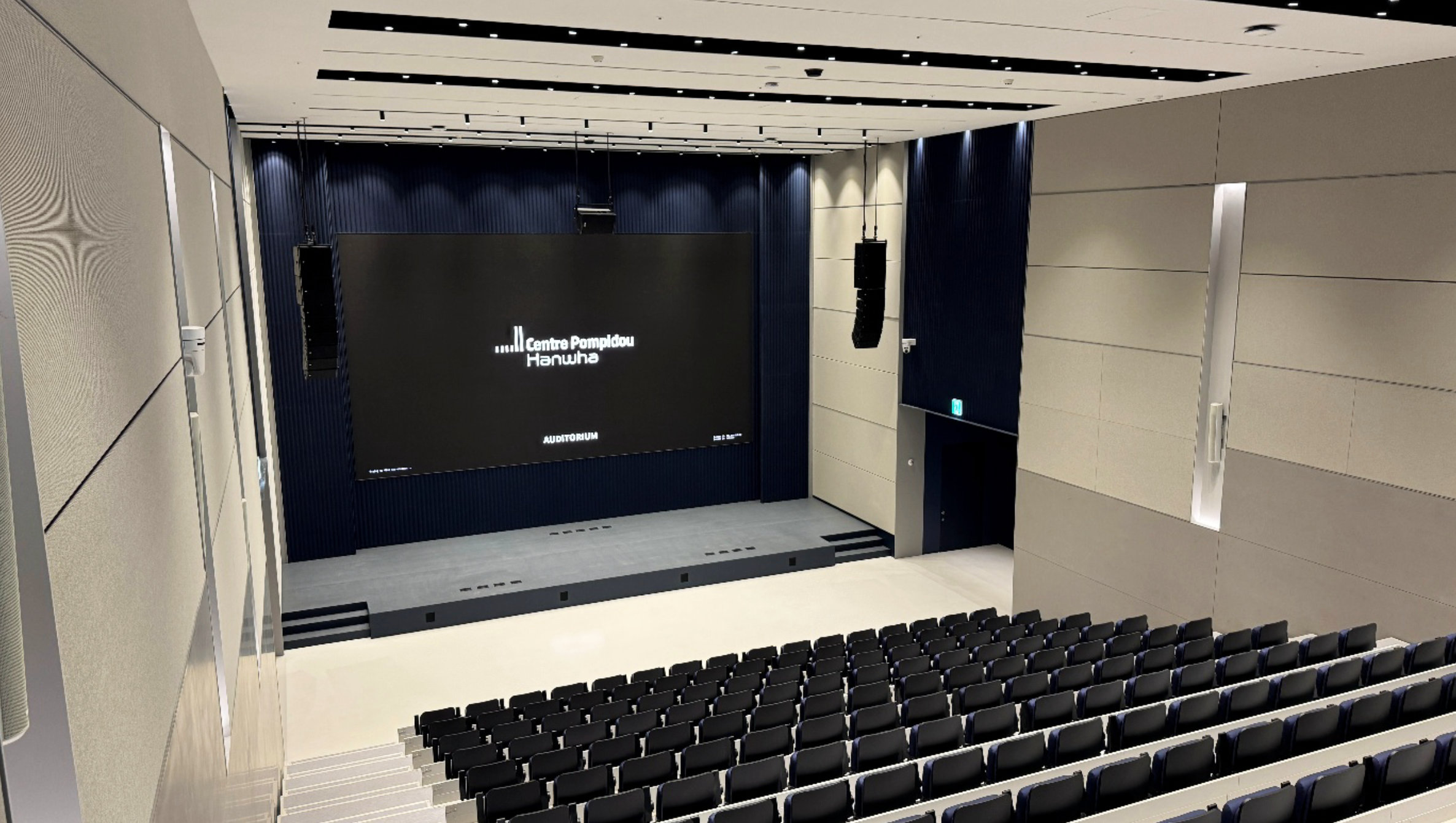
RF-over-Fiber enables discreet, scalable wireless infrastructure in modern conference and corporate environments.
Financial Impact: Cost Savings and Efficiency
One of the most significant financial advantages of RFoF is the ability to centralize receivers. Traditionally, each antenna required its own receiver and associated equipment at the antenna location. With RFoF, multiple antennas can be connected via fiber to a single central receiver bank. This means:
- Fewer receivers are needed overall due to sharing over different locations, reducing CAPEX on hardware.
- Lower maintenance costs, as centralized equipment is easier to service and monitor.
For large venues, broadcasters, or corporate installations, these savings can be substantial. In addition, because fiber termination and cabling are well-established standards in the IT sector, RF specialists are no longer burdened by the physical limitations and signal degradation associated with coaxial cables. This allows them to focus their expertise on critical tasks such as frequency coordination, signal integrity optimization, and advanced system management.
Installation and Flexibility
Fiber cables are lightweight, thin, and easy to install. In many professional buildings, fiber infrastructure has been standard for years and can often be repurposed for RF transmission-further reducing installation cost and complexity.
For mobile use such as OB trucks and live events, tactical fiber is already standard.
RFoF for use with IFB systems
Just as antenna signals can be received over fiber, they can also be transmitted. Antennas can be deployed far from the transmitter using fiber connections. There are some limitations regarding how many RF/IFB signals can be transported, but by following the product guidelines, you are good to go.
Future Trends
The trend in broadcast and live production is toward fewer OB vans and more remote production. RFoF enables centralized control, better resource utilization, and flexible setups that can be adapted quickly to changing requirements. As venues and studios become more complex, RFoF will play an increasingly important role in ensuring reliable, high-quality audio transmission.
Wisycom’s Expertise in RFoF
Wisycom has extensive experience developing RFoF solutions that combine flexibility, quality, and futureproofing. With Wisycom’s products, multiple types of signals can be transmitted over the same fiber, systems can be controlled remotely, and solutions can be tailored to specific needs.
Read more about our RFoF product offering here or contact Wisycom to learn more about how RFoF can optimize your production and audio transmission.